The International Trade Blog  International Sales & Marketing
Exporting to Mexico: What You Need to Know
On: August 5, 2026 | By:  David Noah |
23 min. read
David Noah |
23 min. read
Editor’s Note (August 2026): This article has been updated to reflect recent tariff developments, new customs requirements, and current trade policy considerations for U.S. exporters exporting to Mexico.
Mexico remains one of the most important export markets for U.S. companies and has consistently ranked among the United States’ top trading partners. Thanks to its geographic proximity, highly integrated supply chains, and participation in the United States-Mexico-Canada Agreement (USMCA), Mexico offers significant opportunities for American exporters across industries including manufacturing, industrial equipment, agriculture, technology, healthcare, and consumer products.
Trade between the two countries has grown dramatically over the past decade, with many products crossing the U.S.-Mexico border multiple times during the manufacturing process. This creates deep commercial ties between businesses in both countries.
At the same time, exporting to Mexico has become more complex. Changing tariff policies, the USMCA joint-review process, evolving customs requirements, and shifting supply-chain strategies have created both opportunities and challenges for exporters. Companies entering the Mexican market must pay close attention to product classification, rules of origin, customs documentation, and tariff eligibility under USMCA.
Despite these changes, Mexico remains one of the most accessible and attractive international markets for U.S. exporters. Businesses that understand the trade environment and prepare accordingly can benefit from continued growth in North American trade and manufacturing.
This article looks at the history of U.S. trade with Mexico; how the USMCA has altered trade with that country; the process of exporting to Mexico, including documentation and compliance requirements; and the benefits and considerations for U.S. companies looking to break into the Mexican market.

The United States-Mexico-Canada Agreement (USMCA) and Exporting to Mexico and the 2026 USMCA Review
The United States, Mexico and Canada conducted the first scheduled six-year review of USMCA on July 1, 2026. The United States did not agree to extend the agreement in its current form at that meeting, so the parties did not confirm a new 16-year term. However, USMCA remains in force. Under the agreement, the three countries may agree to an extension later; until they all confirm an extension, the joint-review process continues annually for the remainder of the agreement’s term.
Issues under discussion have included automotive rules of origin, steel and aluminum, economic security, labor, agriculture, electronic payment services and other cross-border trade concerns. Changes resulting from the review process could eventually affect tariff eligibility, supply-chain decisions and compliance requirements.
For exporters, the review highlights the importance of maintaining documentation that demonstrates compliance with USMCA origin requirements and monitoring developments that could affect cross-border trade.
History of USMCA
On July 1, 2020, USMCA replaced NAFTA. Companies seeking preferential tariff treatment under USMCA must confirm that their products meet the agreement’s current rules of origin. A product that qualified under NAFTA did not automatically qualify under USMCA, particularly in industries affected by revised origin and sourcing requirements.
The USMCA modernizes and rebalances U.S. trade relations with Mexico (and Canada) and reduces incentives to outsource by providing labor and environmental protections, innovative rules of origin, and revised investment provisions. The agreement also brings labor and environment obligations into the core text of the agreement and makes them fully enforceable.
Here are some of the highlights:
- Under USMCA, Canada and Mexico agreed to strong enforcement provisions against counterfeiting and piracy, ensuring protection of trade secrets, and ex officio authority for law enforcement officials to stop suspected in-transit counterfeit goods.
- USMCA contains the strongest disciplines on digital trade of any international trade agreement, including rules to ensure that data can be transferred cross-border and minimizing limits on where data can be stored and processed.
- The agreement requires parties to adopt and maintain labor rights recognized by the International Labor Organization, an Annex on Worker Representation in Collective Bargaining in Mexico, and new provisions prohibiting importation of goods produced by forced labor as well as violence against workers exercising their labor rights.
- The USMCA also supports Mexico’s historic labor reform that creates a whole new labor justice system.
- In order to stimulate more North American auto production through updated automotive rules of origin, the agreement increased regional value content for passenger vehicles and light trucks from 62.5 percent to 75 percent.
Under USMCA, the importer makes the claim for preferential tariff treatment to the appropriate customs authority. That claim may be supported by a certification of origin completed by the importer, exporter or producer. Under NAFTA, the exporter or producer generally completed the required certificate of origin, while the importer used that certificate to make the preference claim.
While there is no longer an official certificate of origin form, whichever party is certifying that the goods meet the rules of origin, must provide, at minimum, certain data elements as outlined in the agreement to support the claim. That information can be provided on the invoice or on a separate attached document—a certification of origin. That document can be a hard copy or digital.
Recent Tariffs and Trade Policy Changes
Since 2025, U.S.-Mexico trade has been affected by repeated tariff actions as well as the USMCA review process. Some U.S. tariff measures have treated goods that qualify as originating under USMCA more favorably than non-qualifying goods. However, USMCA eligibility does not necessarily exempt a product from every sectoral, product-specific or trade-remedy tariff.
Although U.S. tariffs on Mexican goods apply to imports into the United States rather than U.S. exports to Mexico, they can still affect integrated supply chains, sourcing decisions and cross-border pricing. For U.S. exporters, determining whether a product qualifies under USMCA remains essential because it affects whether the Mexican importer may claim preferential tariff treatment.
Tariff policies and enforcement priorities can change quickly. Exporters should confirm current tariff treatment, rules of origin, product classification and Mexican import requirements before pricing a transaction or shipping goods.
Facts and Figures on Trade and Exporting to Mexico
Mexico remains the United States' largest trading partner and one of the most important export markets for U.S. companies. According to the latest U.S. government data, total U.S. goods trade with Mexico reached approximately $872.8 billion in 2025, including $338 billion in U.S. exports and $534 billion in imports from Mexico.
Mexico's proximity to the United States, highly integrated manufacturing supply chains, and participation in the USMCA continues to make it one of the most attractive international markets for American exporters. The U.S. goods trade deficit with Mexico totaled $197 billion in 2025, reflecting the growing volume of cross-border trade and manufacturing activity between the two countries.

Exporting to Mexico: The Challenges
U.S. exporters must be aware of certain barriers when exporting to Mexico; however, none are insurmountable. With careful planning and assistance from agencies like the U.S. Commercial Service, exporters of all sizes can be successful in the Mexican market. According to the Mexico Country Commercial Guide, challenges include:
- Mexico’s size and diversity can be difficult to cover with a single distributor or agent. U.S. firms should seek legal counsel before entering into any business agreement.
- The banking system in Mexico offers limited access to affordable financing. Interest rates remain comparatively high, although the Bank of Mexico cut benchmark interest rates in 2024. U.S. companies need to conduct thorough due diligence and be cautious when extending credit.
- The Mexican legal system, which differs in fundamental ways from the U.S. system, can make exporting difficult. U.S. firms should consult with competent legal counsel before entering into any business agreements in Mexico.
- Mexican customs regulations, product standards and labor laws may present challenges for U.S. companies.
- Continued violence involving criminal groups has created heightened insecurity in some parts of Mexico, including some border areas.
U.S. companies need to conduct thorough due diligence on who they partner with, and should be conservative in extending credit and be alert to payment delays. (The U.S. Commercial Service offices in Mexico can conduct background checks on potential Mexican partners to help in this process.)
Exporting to Mexico: The Opportunities
In many situations, the potential rewards of exporting to Mexico outweigh any challenges exporters may face. Exporters should identify and cultivate business opportunities while building a strategy to minimize the risks.
First, the positive impacts of the USMCA mean that Mexico may be a better option for exporting than other countries, as Mexican companies, government agencies, and entire industries are deeply familiar with and receptive to U.S. products and services. U.S. producers often find it straightforward to market and sell products and services in Mexico.
The USMCA improves market access for U.S. companies in several important ways, specifically through intellectual property rights, digital trade, labor obligations, environmental obligations and automotive manufacturing.
Mexico’s most promising sectors include the following:
- Aerospace
- Automotive
- Chemicals
- Cybersecurity
- Defense
- Digital economy
- Education services
- Financial services
- Oil and gas
- Power
- Safety and security
- Transportation infrastructure
- Travel and tourism
- Waste and recycling technology
- Water technology
Nearshoring and Manufacturing Opportunities
Mexico has become one of the primary beneficiaries of the global nearshoring trend. As companies seek to diversify supply chains and reduce dependence on overseas manufacturing, many businesses are expanding operations in Mexico to serve the North American market.
This shift has increased demand for:
- industrial machinery
- manufacturing equipment
- automation technology
- construction materials
- logistics services
- engineering and technical expertise
For many U.S. exporters, Mexico is no longer just an export destination; it's an integral part of their North American supply chain.
Export Assistance
The best thing about exploring the opportunities to export to Mexico is knowing you don’t need to go it alone. If you’re wondering how to export to Mexico, you can rely on assistance from your in-country allies, including the U.S. Commercial Service office, trade missions, and chambers of commerce.
U.S. Commercial Service Offices
One of the first places to consider are your local and in-country U.S. Commercial Service offices. The Commercial Service in-country offices offer U.S. exporters business partners in Mexico—boots on the ground in the country. Commercial service offices also include representation by an agent, distributors or partners who can provide essential local knowledge and contacts that can be critical for your success.
You can learn more about in-country offices in our article, Tapping into the U.S. Commercial Service's In-Country Offices.
District Export Councils (DECs)
DECs across the country help exporters by supporting trade and services that strengthen individual companies, stimulate U.S. economic growth, and create jobs. DEC members also serve as mentors to new exporters and provide advice to smaller companies.
Sponsored by state and local trade offices as well as commercial service offices, trade missions offer introductions to important contacts and networking opportunities. Check into them.
International Trade Administration
The ITA is an excellent resource to help you combat trade problems. ITA staff members are resident experts in advocating for U.S. businesses of all sizes. They customize their services to help solve your trade dilemmas as efficiently as possible. Plus, the ITA makes it easy to report a problem, allowing you to submit your report online.
Chambers of Commerce
Chambers of Commerce may also be a resource when exporting to France. You can learn more about various chambers and how they can help smooth the way for your export activities in our article, The Chamber of Commerce Role in Exporting.
Export Document Requirements for Mexico
Export documentation and procedures for Mexico are as critical as they are for any other country. Mexico is not subject to any special U.S. export control regulations, and it is designated as a Category I country (the least restrictive) for receipt of U.S. high-technology products. Other documents you need to export to Mexico from the U.S. will vary depending on your products, but may include:
- Bill of lading
- Commercial invoice
- USMCA Certification of Origin
- Packing list
- Sales contract
- Proforma invoice
- AES filing
- Customs declaration
- Insurance policy

Tariffs and Duties When Exporting to Mexico
Mexico and the United States continue to trade under the framework of the USMCA. For many products that meet USMCA rules of origin requirements, tariffs remain at or near zero. However, recent trade actions have demonstrated that tariffs can still affect specific industries and product categories.
Exporters should:
- Verify the correct HS classification for their products.
- Determine whether goods qualify under USMCA rules of origin.
- Monitor tariff developments affecting automotive, steel, aluminum, and other strategic sectors.
- Work with customs brokers and trade compliance professionals when needed.
Export Compliance Issues When Exporting to Mexico
It’s important to understand the regulations covering exports to Mexico, especially export controls.
Product Classification for Export Controls
The first step in ensuring export compliance is determining who has jurisdiction over your goods: the U.S. Department of Commerce under the Export Administration Regulations (EAR) or the State Department's International Traffic in Arms Regulations (ITAR).
If your goods fall under the jurisdiction of the Commerce Department—which most products do—you must determine if your export requires authorization from the Bureau of Industry and Security (BIS, part of the Commerce Department). To make that determination, first answer the following questions:
- What is the Export Control Classification Number (ECCN) of the item?
- Where is it going?
- Who is the end user?
- What is the end use?
There are three ways to classify your products for export controls: You can self-classify your products, submit a SNAP-R request for a ruling, or rely on the product vendor to provide the information. If you’re self-classifying, Shipping Solutions Product Classification Software makes the process easier than manually searching through codes and regulations. You can give it a try for free here.
Export License Determination
Next, companies must use the ECCN codes and reasons for control described above to determine whether or not there are any restrictions for exporting their products to specific countries. Once they know why their products are controlled, exporters should refer to the Commerce Country Chart in the EAR to determine if a license is required.

Although a relatively small percentage of all U.S. exports and reexports require a BIS license, virtually all exports and many reexports to embargoed destinations and countries designated as supporting terrorist activities require a license. Countries fitting that bill are Cuba, Iran, North Korea and Syria.
Part 746 of the EAR describes embargoed destinations and refers to certain additional controls imposed by the Office of Foreign Assets Control (OFAC) of the Treasury Department.
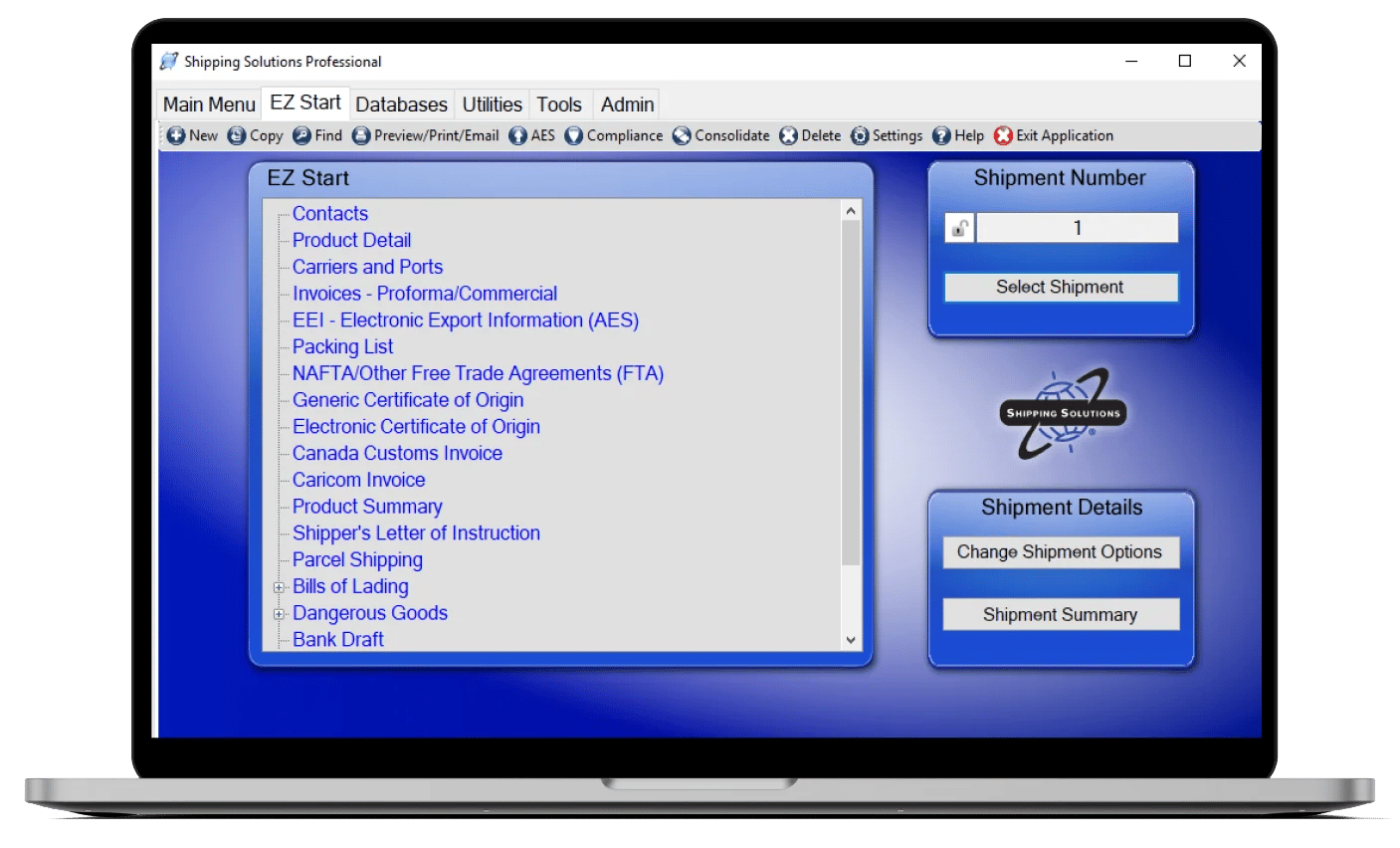
Shipping Solutions Professional export documentation and compliance software includes an Export Compliance Module that uses the ECCN code for your product(s) and the destination country to tell you if an export license is required. If indicated, you must apply to BIS for an export license through the online Simplified Network Application Process Redesign (SNAP-R) before you can export your products.
There are export license exceptions, like low-value or temporary exports, that allow you to export or reexport, under stated conditions, items subject to the Export Administration Regulations (EAR) that would otherwise require a license. These license exceptions cover items that fall under the jurisdiction of the Department of Commerce, not items controlled by the State Department or some other agency.
Deemed Exports
Surprise! You may be an exporter without even knowing it! Deemed exports, or the disclosure of information or services rather than an actual product, is an important issue to pay attention to when exporting. A deemed export occurs when technology or source code (except encryption and object source code, which is separately addressed in the EAR, is released to a foreign national within the United States.
Sharing technology, reviewing blueprints, conducting tours of facilities, and other information disclosures are considered potential exports under the deemed export rule and should be handled accordingly.
Restricted Party Screenings
Restricted party lists (also called denied party lists) are lists of organizations, companies or individuals that various U.S. agencies—and other foreign governments—have identified as parties that one can’t do business with. There are several reasons why a person or company may be added to a restricted party list. For example, they may be a terrorist organization or affiliated with such an organization; they may have a history of corrupt business practices; or they may otherwise pose a threat to national security.
Restricted party screening (or denied party screening) refers to the process in which a company checks a potential customer or business partner against one or more of the restricted party lists to ensure their potential partners are legally accepted. The primary restricted party lists in the United States are published by the Department of Commerce, Department of State, and Department of Treasury. However, several other agencies produce lists as well. These agencies recommend that companies perform restricted party screening periodically and repeatedly throughout the movement of goods in the supply chain.
When exporting to Mexico, it’s imperative you check every single restricted party list every time you export because:
- Fines for export violations can reach up to $1 million per violation in criminal cases.
- Administrative cases can result in a penalty amounting to $250,000 or twice the value of the transaction, whichever is greater.
- Criminal violators may be sentenced to prison for up to 20 years, and administrative penalties may include denial of export privileges.
Shipping Solutions Restricted Party Screening Software makes it fast and easy to check hundreds of lists at once, and it provides detailed information about potential matches, so you can make an informed decision about what to do next. Give it a try for free.
Key Takeaways: Exporting to Mexico
Mexico remains one of the most important export markets for U.S. businesses and a cornerstone of North American trade. Strong consumer demand, integrated supply chains, and the benefits of the USMCA continue to create significant opportunities for exporters across a wide range of industries.
However, evolving tariff policies, ongoing USMCA negotiations, and changing supply-chain strategies mean exporters must stay informed about trade developments. Companies that understand Mexico's regulatory environment, leverage USMCA benefits, and maintain strong trade compliance practices will be well positioned for long-term success in the Mexican market.
That’s where Shipping Solutions can help.
With Shipping Solutions export documentation and compliance software, exporters can quickly create accurate export documents, run restricted party screenings against hundreds of lists at once, and reduce the risk of costly compliance mistakes.
For companies that want additional support, GLOBAL GATEWAY by Shipping Solutions brings everything together in one place. This all-in-one export management service combines expert compliance support, integrated export documentation and discounted international shipping in a single streamlined solution.
Whether you’re just beginning to export or already shipping worldwide, Global Gateway works like an extension of your logistics team—without the added overhead.
You don’t need to master every detail of international trade to succeed globally. You just need the right partner.
Schedule a free, no-obligation consultation to learn how we can support your exports.
This is one in a series of articles exploring exporting to specific countries across the globe—we previously featured ASEAN countries, Australia, Brazil, Canada, China, the EU, France, Germany, India, Israel, Japan, Mexico, the Netherlands, Russia, South Korea, Taiwan and the United Kingdom.
Like what you read? Subscribe today to the International Trade Blog to get the latest news and tips for exporters and importers delivered to your inbox.