The International Trade Blog  Export Compliance
HS Codes, HTS Codes and Schedule B Codes: What's the Difference?
On: August 3, 2026 | By:  David Noah |
13 min. read
David Noah |
13 min. read
 Do you know the difference between HS codes, HTS codes and Schedule B codes? In casual conversation, exporters tend to use these terms interchangeably; they, for the most part, understand that these are codes representing classifications of products.
We've been helping people correctly classify their goods with Shipping Solutions for decades and while it’s not wrong to use those terms interchangeably in casual conversation, it is important to understand the differences—if not, you could get into trouble, and your shipment could, too!
.png?width=800&name=HS%20Codes%2c%20HTS%20Codes%20and%20Schedule%20B%20Codes%20Whats%20the%20Difference%20(1).png)
Here are definitions of the terms and examples of use cases when it is appropriate to use each term:
What is a Harmonized System (HS) Code?
The Harmonized System classification is a six-digit standard, called a subheading, for classifying globally traded products. HS codes, also called HS numbers, are used by customs authorities around the world to identify the duty and tax rates for specific types of products. You can learn more about these codes in our comprehensive resource for all exporters—Classifying Your Products for International Trade.
- HS codes are administered by the World Customs Organization. HS codes are recognized in 98% of world trade.
- There are six digits in an HS code. You use an HS code because it is a universal classification tool. Many governments add additional digits to the HS number to further distinguish products in certain categories. These additional digits are typically different in every country.
- HS codes are used in most international export documentation and commercial invoices.
Use Case: You’ll use an HS number when you are referencing the classification with your customers, vendors and anyone outside of the U.S.
When you’re completing export documentation, any documents that are used internationally, such as the commercial invoice, should display the six-digit HS code instead of a longer code. If you use a 10-digit code, the numbers may not be accurate for the country of import.
Example: Harmonized System Codes
Chapter 66 of the Harmonized System includes the following products: "Umbrellas, sun umbrellas, walking-sticks, seat-sticks, whips, riding-crops and parts thereof." If your company is importing or exporting "umbrella frames, including frames mounted on shafts (sticks)," as defined by the World Customs Organization, the correct six-digit HS number is 6603.20. That is the number you would want to use on your international paperwork, because the last four digits of the 10-digit number may be different in every country.

What is an HTS code or HTSUS code?
The Harmonized Tariff Schedule of the United States (HTSUS) is a 10-digit import classification system that is specific to the United States. HTS codes, also called HTS numbers or HTSUS codes, are administered by the U.S. International Trade Commission (USITC). It’s very important that all U.S. importers know and use the correct HTSUS codes because commodity duties are assessed based on this classification. An HTS code takes the same form as an HS code for the first six digits and then has four differing last digits.
Use Case: If you are a U.S. importer, this is the code you must use. The comprehensive classification list is available for free on the ITC website.
Example: Harmonized Tariff Codes
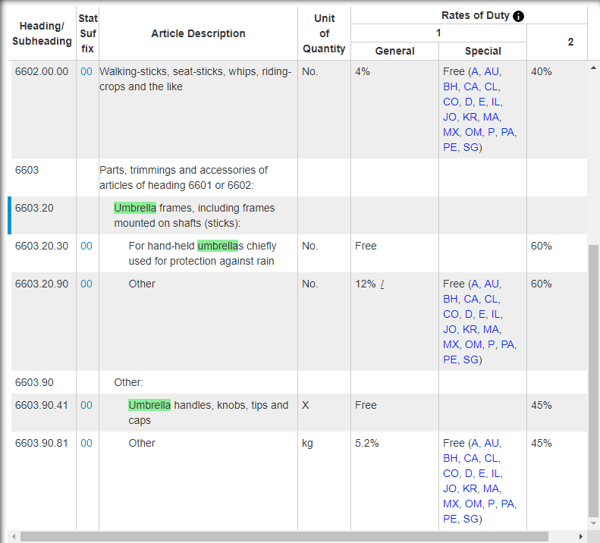
Let’s look again at the example for umbrella frames. According to the HTSUS, the correct classification "For hand-held umbrellas chiefly used for protection against rain" is 6603.20.3000 or 6603.20.9000 for all other umbrella frames. That designation is important. The umbrella frames with the first HTS code can enter the U.S. duty-free; the umbrella frames for the latter have a 12% general duty rate.
.webp?width=600&height=170&name=HTS%20Code%20for%20Umbrellas%20(1).webp)
Global and U.S. HS codes have four components, which are identified by the green numerals beneath the digits:
1. Chapter: In this example, 66 is the chapter.
2. Heading: In this example, 6603 is the heading. The heading dictates the specific category within any particular chapter.
3. Subheading: 6603.20 is the subheading. The last two digits of the international Harmonized Code are more specific, defining subcategories of products.
4. Extra digits: 6603.20.3000 is the suffix or extra digits. Countries can use an additional two to four digits for country-specific categorizations. For example, the United States relies on 10-digit codes called HTSUS numbers.
You can learn more about HTS codes in our two-part series, The Harmonized Tariff Schedule: General Rules of Interpretation Never Written (But Used Daily) and The Harmonized Tariff Schedule: Beyond the General Rules of Interpretation.
You can look up HTS codes here using the ITC's free search tool:
Why Is the Difference Important?
It’s important to understand the variations in HS numbers versus HTS and Schedule B codes because the four-digit difference could change the classification of your international export. For exports, you can’t simply use an HTS or Schedule B number in place of an HS number.
Consider the above example of umbrellas: Imagine you’re exporting parts for umbrellas. In the United States, they are identified by the HTS code 6603.20.3000. If you’re exporting these to Germany, and you complete the commercial invoice using all 10 digits of that code, the German importer’s paperwork will be rejected—in Germany, the correct number is 6603.20.0000.
As you can see, the first six digits (the HS numbers) are identical. The difference comes in the last four digits. Though the HS code subheading is the same, the HTSUS for umbrellas is one digit different than the German code, making it incorrect.

What is a Schedule B Code?
The Schedule B code is a 10-digit subset of HTS codes for U.S. exporters. Schedule B codes are used for statistical purposes by the U.S. government to monitor U.S. exports.
- Schedule B codes are maintained by the U.S. Census Bureau instead of the ITC.
- As with HTS codes, the first six digits of a Schedule B code should be the same as an HS number; however, the last four digits may be different even than the HTS code.
Use Case: Companies that export will typically use the appropriate Schedule B codes for their products rather than HTS codes on their export paperwork and when filing their EEI through the Automated Export System (AES). Since the Schedule B codes are a subset of the HTS codes, it's usually quicker and easier to classify products under Schedule B than HTS.
Companies that are already classifying their products using the HTS codes for their imports may want to use HTS classification for all their products to eliminate the need to classify their products twice—once under HTS and once under Schedule B. That is perfectly acceptable, but do keep in mind that certain HTS codes can't be used for exporting.
Also, the reverse is not true. You cannot use Schedule B codes in place of HTS codes for import classifications.
Example: Schedule B Codes
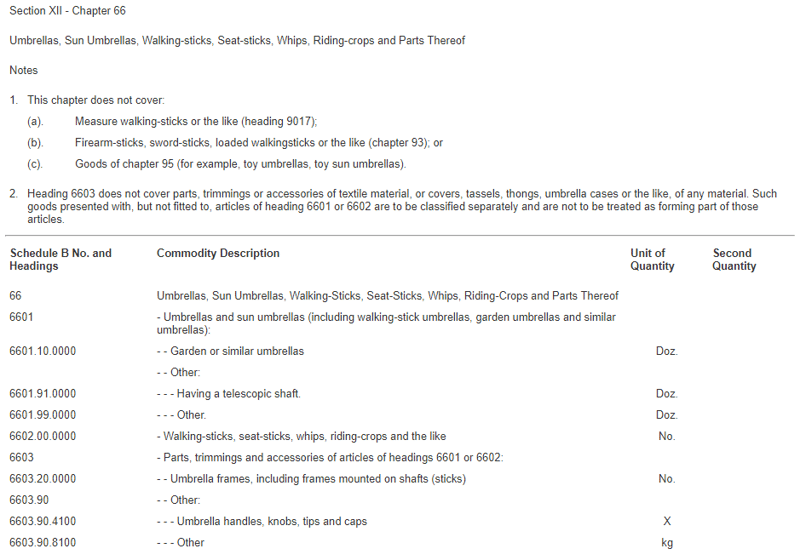
In this example, umbrella frames are classified for export under Schedule B code 6603.20.0000. Notice that the first six digits match the HS code, but the full 10-digit Schedule B code provides the U.S.-specific export reporting classification. Exporters should use the current Schedule B search tool or Schedule B book to confirm the correct code before filing Electronic Export Information (EEI) through AES.
You can look up Schedule B Codes here using the Census Bureau's search tool:

When Not to Use a Classification Code
Some exporters prefer not to include an HS code on their commercial invoices. As a general rule, I think it's a good idea to include the proper code on the invoice, but I address some reasons why you might not in our article Why You Shouldn’t Include HS Numbers on a Commercial Invoice.
Changes to HS, HTS and Schedule B Codes
Like most things in life, the Harmonized System, Harmonized Tariff Schedule and Schedule B codes for your products can change. Every five years, the WCO reviews HS numbers to ensure they reflect changes and updates in technology and that they provide visibility into new product streams and emerging global issues. The seventh edition of the HS, called HS 2022, entered into force on January 1, 2022.
The eighth edition of the HS will be delayed a year because of COVID and will enter into force on Jan. 1, 2028. The 2028 HS updates were officially adopted in January 2026 and are available for review on the WCO website.
Since the HTS and Schedule B codes are based on the WCO's HS Codes, it's logical to assume that those codes are updated as well to reflect those changes. But that's not the only time those updates can occur. The U.S. International Trade Commission released 10 revisions to the HTSUS in 2024 and 32 revisions in 2025. You'll find the latest set of HTS revisions in 2026 on the USITC website. As you can see, you must regularly review the classifications for your products to ensure you're using the correct, current codes.
Why You Need to Understand These Terms
Properly classifying your products is an important part of both export and import compliance. Using the wrong code can lead to shipment delays, incorrect duties, reporting errors, audits and penalties. Deliberately misclassifying products can have even more serious consequences.
The challenge is that classification isn’t always obvious. Similar products may fall under different codes depending on their materials, use, technical characteristics or country-specific tariff schedule. That’s why exporters and importers need a consistent process for researching, assigning and maintaining classification codes.
Shipping Solutions Product Classification Software helps companies manage that process more efficiently. It gives you a centralized place to store product classifications, document classification decisions, and reduce repetitive lookup work each time you create export or import documents. By keeping classification information organized and accessible, your team can save time, reduce errors and support stronger compliance procedures. You can try it for free!
Like what you read? Subscribe today to the International Trade Blog to get the latest news and tips for exporters and importers delivered to your inbox.
This article was first published in November 2015 and has been updated to include current information, links and formatting.