The International Trade Blog  Import Procedures
Country of Origin Determination: What U.S. Importers Need to Know
On: April 1, 2026 | By:  David Noah |
10 min. read
David Noah |
10 min. read
 If you ask an importer where their product comes from, the answer often sounds simple.
“China.”
“Vietnam.”
“Mexico.”
But when U.S. Customs and Border Protection (CBP) asks the same question, the answer sometimes isn’t nearly that straightforward.
Today’s supply chains are global. Raw materials may come from one country, components from another and final assembly from a third. Determining the correct country of origin can require a careful review of the manufacturing process.
And that determination matters more than ever.
Country of origin can determine duty rates, eligibility for trade programs and whether additional tariffs apply. It also affects product marking requirements and can trigger enforcement scrutiny under laws such as the Uyghur Forced Labor Prevention Act (UFLPA).
With Section 301 tariffs, anti-dumping duties and increased enforcement under the Enforce and Protect Act (EAPA), inaccurate origin declarations can lead to serious consequences. Importers are expected to exercise reasonable care when declaring the country of origin of their products.

What Is Country of Origin Determination?
Country of origin determination is the process of identifying the country where a product was manufactured or substantially transformed. U.S. Customs and Border Protection uses the country of origin to assess duties, apply tariffs and determine marking requirements for imported goods.
Let’s take a closer look at how country of origin determination works and why it deserves careful attention.
Why Country of Origin Matters
Country of origin affects several critical aspects of importing into the United States.
These include:
- Duty rates under the Harmonized Tariff Schedule (HTS)
- Additional tariffs, such as Section 301 duties on goods from China
- Eligibility for preferential trade programs
- Import restrictions, quotas or sanctions
- Country of origin marking requirements
CBP relies on accurate origin information to assess duties and determine whether imported goods are admissible.
If an importer incorrectly declares origin—whether intentionally or by mistake—the company may face penalties, duty reassessments or investigations.
You can read more about the growing importance of origin compliance in our article, Why Country of Origin Matters More Than Ever for Importers.

How Importers Determine the Country of Origin of Their Products
In its simplest form, the country of origin is the country where a product was manufactured, produced or grown.
If a product is wholly produced in one country, determining origin is straightforward. For example, agricultural goods grown entirely in a single country clearly originate there.
However, most manufactured products today involve materials or components from multiple countries. When that happens, CBP looks at whether the manufacturing process in a particular country resulted in a substantial transformation of the product.
The regulations define country of origin in 19 CFR §134.1 as the country of manufacture, production or growth of an imported article. Further work or material added to the article in another country must effect a substantial transformation in order for that other country to become the country of origin.
In other words, not every manufacturing step changes origin.
The key question is whether the process results in a new and different article of commerce with a new name, character or use.
Substantial Transformation: The Key Concept
The concept of substantial transformation is central to country of origin determination.
A product is considered substantially transformed when processing in a country results in a new article with a different name, character or use.
Here’s a simplified example:
Suppose a company imports electronic components from several countries and assembles them into a finished circuit board in Malaysia. If the assembly process is complex and results in a new commercial product—a functional circuit board—CBP may determine that Malaysia is the country of origin.
But not every manufacturing activity qualifies.
For example:
- Packaging products into retail containers
- Simple assembly operations
- Painting or finishing
- Dilution or mixing with water
- Cleaning, laundering or minor repairs
These types of activities generally do not change the country of origin.
The details matter. CBP evaluates origin determinations based on the specific manufacturing steps involved.
A Common Real-World Scenario
Consider a situation that many importers face today.
A product’s components are manufactured in China. To avoid Section 301 tariffs, the components are shipped to another country—for example Vietnam—where they are assembled into a finished product.
Some companies assume the origin automatically becomes Vietnam.
That is not always correct.
If the assembly performed in Vietnam is minimal or does not substantially transform the product, CBP may determine that the country of origin remains China.
In that case, the product could still be subject to Section 301 tariffs and additional scrutiny.
This is one reason CBP has increased enforcement activity under the Enforce and Protect Act (EAPA), which allows investigations into evasion of anti-dumping or countervailing duties through transshipment or improper origin declarations.
Country of Origin for Marking Purposes
In addition to duty assessment, country of origin also determines product marking requirements.
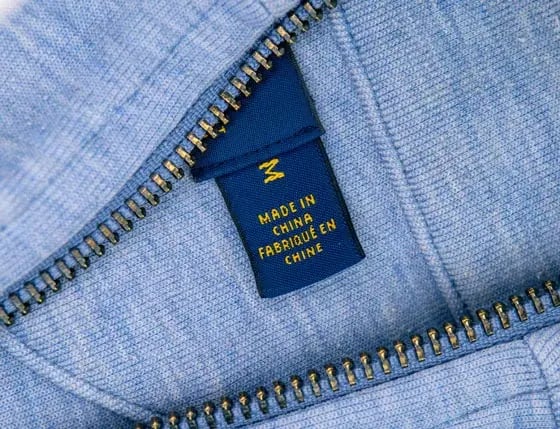
Under U.S. law, most imported goods must be marked with their country of origin so the ultimate purchaser in the United States can identify where the product was made.
These marking requirements are governed primarily by 19 CFR Part 134.
For example, a product may need to be labeled:
- “Made in Mexico”
- “Product of Germany”
- “Manufactured in Vietnam”
CBP places significant emphasis on origin marking because it provides transparency to consumers and businesses.
You can learn more about these rules in our article on country of origin labeling.
Special Rules for Textiles and Apparel
Textile and apparel products follow their own set of origin rules.
For goods classified in Chapters 50 through 63 of the Harmonized Tariff Schedule, country of origin is determined under regulations found in 19 CFR §102.21.
These rules focus heavily on specific manufacturing processes such as:
- Where the fabric was formed
- Where the yarn was spun
- Where the garment was cut and sewn
Because textile supply chains often involve multiple countries, these rules can be more prescriptive than the general substantial transformation test.
Country of Origin vs. Free Trade Agreement Qualification
One point that often causes confusion is the relationship between country of origin and free trade agreements.
Determining the country of origin of a product does not automatically mean the product qualifies for preferential duty treatment under a trade agreement.
Trade agreements such as USMCA use detailed rules of origin, which are typically based on:
- Tariff classification changes
- Regional value content requirements
- Specific manufacturing processes
These rules can be significantly more complex than standard origin determinations.
For a broader discussion of trade agreements and how they work, see our article, Trade Agreements—FTAs, PTAs, Unilateral, Bilateral, Multilateral: How Do They Differ?

The Risk of Relying Only on Supplier Statements
One of the most common origin mistakes occurs when importers rely entirely on information provided by suppliers.
For example, an importer might receive an invoice stating that a product was made in Thailand. Without additional verification, the importer declares Thailand as the country of origin when filing entry documentation.
However, if the supplier sourced most of the product from another country and only performed minor processing in Thailand, CBP may determine that the declared origin is incorrect.
Importers are expected to exercise reasonable care, which may include understanding how the product is actually manufactured.
This may require reviewing:
- Bills of materials
- Manufacturing flow charts
- Supplier certifications
- Production records
Failing to verify origin information can expose companies to duty liability or enforcement actions.
Some cases involving incorrect origin declarations have even led to lawsuits under the False Claims Act.
Common Country of Origin Mistakes Importers Make
Even experienced importers sometimes misunderstand how country of origin is determined. Common mistakes include:
- Assuming the country of final assembly is always the country of origin
- Relying solely on supplier invoices without understanding the manufacturing process
- Confusing country of origin with free trade agreement eligibility
- Assuming minor processing such as packaging, labeling or simple assembly changes origin
Because additional tariffs such as Section 301 duties may apply depending on origin, these mistakes can lead to unexpected duty exposure.
How Importers Can Exercise Reasonable Care
Reasonable care in country of origin determination doesn’t necessarily mean auditing every supplier. But it does require more than simply accepting what appears on an invoice.
Importers should consider steps such as:
- Understanding the key manufacturing processes involved in their products
- Identifying where substantial transformation occurs
- Maintaining documentation supporting origin determinations
- Reviewing origin when suppliers change production locations
- Asking suppliers for detailed origin information when necessary
In complex cases, importers may also request a binding ruling from CBP to confirm the proper country of origin determination.
These rulings provide official guidance and can help reduce uncertainty when supply chains involve multiple countries.
You can see how origin decisions can be influenced by legal interpretations in our discussion of a recent case here: Ramifications of a Recent Court Decision on Determining the Country of Origin for Imports.
Final Thoughts
Country of origin determination is sometimes treated as a routine customs data element.
In reality, it can have significant financial and compliance implications.
With additional tariffs, increased supply chain scrutiny and stronger enforcement tools available to regulators, importers are expected to understand how the country of origin of their products is determined.
That doesn’t mean every importer must become a trade lawyer. But it does mean asking the right questions about how products are manufactured and where substantial transformation occurs.
When importers take the time to understand those details, they put themselves in a much stronger position to meet their compliance responsibilities and avoid costly surprises.
Like what you read? Subscribe today to the International Trade Blog to get the latest news and tips for exporters and importers delivered to your inbox.
This article was originally published in 2016 and has been substantially updated to reflect today’s trade enforcement environment, including Section 301 tariffs, UFLPA supply chain scrutiny and EAPA investigations. The discussion of country of origin determination has been expanded with practical examples and updated regulatory context.